




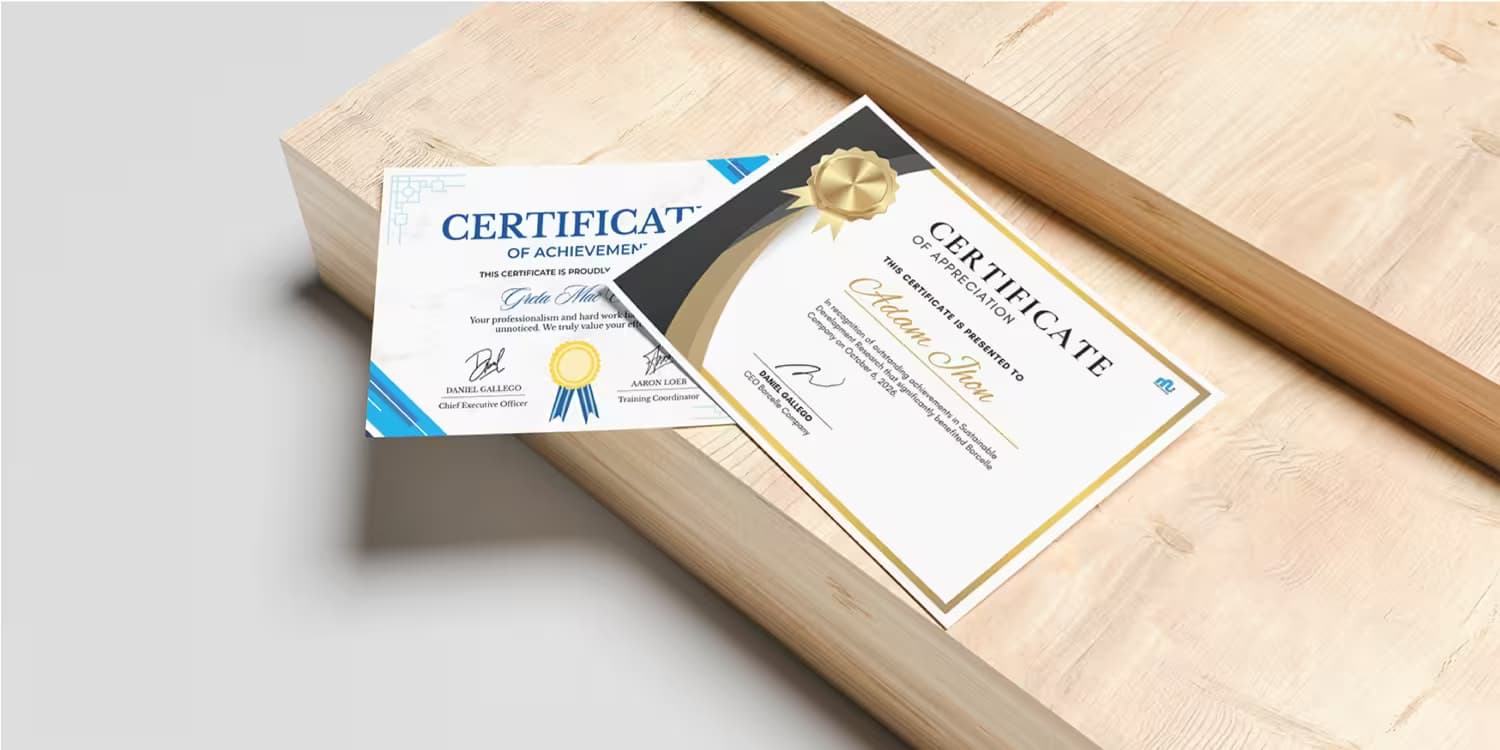
Certificate Size: Standard Certificate Dimensions in India
Certificate Size: Standard Certificate Dimensions in India The standard certificate size in India is A4 — 210 mm × 297

The standard certificate size in India is A4 — 210 mm × 297 mm (8.27" × 11.69"). It's the most widely used format across schools, colleges, corporates, and training institutes. For premium awards meant to be framed, A3 (297 mm × 420 mm) is the preferred choice. For bulk participation certificates, A5 (148 mm × 210 mm) is the most cost-effective option. But choosing the right size depends on more than just convention — it depends on the occasion, the audience, and how the certificate will be used or displayed. This guide covers everything we know about getting certificate sizes and printing right, so you don't have to learn it the hard way.
In this guide, we'll walk you through all standard certificate sizes used in India, explain what each size is best suited for, and help you pick the right dimensions before you send your file to print.
Why Does Certificate Sizes Matter?
Before we dive into the dimensions, let's quickly understand why size is such an important decision:
- Presentation value — A larger certificate feels more premium and carries more perceived value
- Frame compatibility — Standard sizes fit standard frames, saving you money and hassle
- Text and design space — The right size gives your content room to breathe without looking cramped or stretched
- Portability — If recipients need to carry or file certificates, oversized formats become inconvenient
Get the size wrong, and even the most beautifully designed certificate can look unprofessional when printed.
Standard Certificate Sizes Used in India
1. A4 Size — 210 mm × 297 mm (8.27" × 11.69")
If there's one size that dominates certificate printing across schools, colleges, corporate offices, and training institutes in India — it's A4. It's the default paper size used in most printers, and that makes it incredibly convenient for both printing and filing.
Best for:
- School participation and achievement certificates
- Workshop and seminar completion certificates
- Employee of the Month or quarterly recognition certificates
- Course completion certificates from online platforms and coaching institutes
- Government and institutional certificates
Why people love A4:
- Fits into standard document folders and files without folding
- Widely available frames in this size
- Easy to print on any office or professional printer
- Looks formal without being oversized
Design tip: Keep a minimum margin of 15–20 mm on all sides. If you're adding a border or decorative frame, ensure it doesn't crowd the text area.

2. A3 Size — 297 mm × 420 mm (11.69" × 16.54")
A3 certificate sizes are exactly double the size of A4, and that extra real estate makes a big visual impact. When you want a certificate to command attention — say, a major achievement award or a lifetime recognition honour — A3 is the format of choice.
Best for:
- Annual achievement awards and trophies accompaniment
- Long-service recognition certificates
- Championship or competition winner certificates
- Appreciation certificates for key clients or partners
- Ceremonial and framed wall displays
Why people choose A3:
- Large format = premium feel and visual weight
- Gives designers space for richer graphics, logos, and signatures
- Ideal for framing and display in offices or institutions
- Makes a strong impression during award ceremonies
Things to keep in mind: A3 certificates are typically printed on heavier paper stock (120–200 GSM) to maintain quality and prevent warping. They also require specific A3-compatible printers or professional print services like Quapri.
3. A5 Size — 148 mm × 210 mm (5.83" × 8.27")
A5 is exactly half of A4, and it works beautifully for situations where you want something a little more personal and lightweight. Think of it as the "thank you card" version of a certificate — smaller, quicker to hand out, and easy to keep.
Best for:
- Participation certificates for large events or competitions
- Student merit cards and academic recognitions
- Volunteer appreciation certificates
- Internal HR recognition like "Star of the Week"
- Gift voucher-style certificates
Why people choose A5:
- Cost-effective, especially when printing in bulk
- Fits easily into an envelope for mailing
- Less intimidating for casual, everyday recognition
- Easy to store and carry
Design tip: A5 has limited space, so keep your design clean and minimal. Prioritise the name, achievement, and signature — and let your logo and background do the heavy lifting visually.


4. Letter Size — 215.9 mm × 279.4 mm (8.5" × 11")
Letter size is the standard paper format used in the United States, and it's widely used in India by multinational companies, international schools, and global training and certification bodies.
Best for:
- Certificates issued by international organisations or franchise brands
- Corporate compliance and training certificates (ISO, Six Sigma, etc.)
- Professional certification bodies following US standards
- Certificates meant to align with foreign parent company formats
Key difference from A4: Letter is slightly wider (8.5" vs 8.27") and shorter (11" vs 11.69") than A4. The difference is subtle, but it matters when designing templates — make sure your designer specifies the right size to avoid awkward cropping or white borders.
5. Legal Size — 215.9 mm × 355.6 mm (8.5" × 14")
Legal size is longer than both A4 and Letter, and it's used when a certificate needs to carry more information — such as detailed terms, licensing content, or compliance statements.
Best for:
- Licence and accreditation certificates
- Professional membership certificates (for associations, federations, etc.)
- Formal appreciation letters that double as certificates
- Certificates with detailed content or multiple authority signatures
Note: Legal size is less commonly used for design-heavy certificates. It's more suited for text-rich formats with an official document feel.


6. Custom/Landscape Certificate Sizes
Not every certificate needs to follow a standard dimension. Landscape orientation and custom certificate sizes are increasingly popular for modern, design-forward certificates.
Common landscape formats used in India:
| Format | Dimensions |
|---|---|
| Landscape A4 | 297 mm × 210 mm |
| Landscape A3 | 420 mm × 297 mm |
| Custom Panoramic | 330 mm × 210 mm |
| Square Certificate | 210 mm × 210 mm |
Best for:
- Corporate awards with rich visual design
- Certificates meant for social media sharing (digital format)
- Sports and cultural events
- Branded certificate programmes for ed-tech or online courses
Pro tip: If your certificate will be shared as a digital PDF or image as well as printed, a landscape format often looks better on screen than portrait.
Certificate Sizes at a Glance
| Size | Dimensions (mm) | Dimensions (inches) | Best For |
|---|---|---|---|
| A4 | 210 × 297 | 8.27 × 11.69 | General use, schools, corporate |
| A3 | 297 × 420 | 11.69 × 16.54 | Premium awards, framed display |
| A5 | 148 × 210 | 5.83 × 8.27 | Participation, bulk events |
| Letter | 215.9 × 279.4 | 8.5 × 11 | International/MNC use |
| Legal | 215.9 × 355.6 | 8.5 × 14 | Formal, accreditation |
| Landscape A4 | 297 × 210 | 11.69 × 8.27 | Modern, design-forward |

Paper Stock Recommendations for Certificate Printing
The size is just one part of the equation. The paper quality plays an equally important role in how a certificate looks and feels.
Here's a quick reference:
| Paper Weight | Feel | Recommended For |
|---|---|---|
| 90–100 GSM | Standard, light | Participation certificates, bulk printing |
| 120–150 GSM | Medium, crisp | Office recognitions, training certificates |
| 170–200 GSM | Heavy, premium | Achievement awards, corporate events |
| 250–300 GSM | Card-stock, rigid | Framed awards, permanent display certificates |
At Quapri, we print certificates on a range of paper stocks — from standard 100 GSM to premium 300 GSM art card — so you get exactly the look and feel you need.
Design Tips for a Professional-Looking Certificate
No matter what size you choose, these design fundamentals will help your certificate look polished:
- Use the right resolution Always design at 300 DPI (dots per inch) for print. Low-resolution designs look pixelated and blurry when printed.
- Set up bleed and safe zone
- Add 3 mm bleed on all sides if your design extends to the edges
- Keep important text and logos at least 5–10 mm away from the trim line
- Choose print-safe fonts Avoid very thin or decorative fonts below 10pt — they lose clarity in print. Stick to clean serif or sans-serif fonts for readability.
- Use CMYK colour mode RGB colours are for screens; CMYK is for print. Always convert your design to CMYK before sending to print to avoid colour surprises.
- Leave breathing room for signatures If your certificate includes a physical signature line, ensure there's enough white space for a clean, legible signature.
Certificate Printing Guide
You've chosen the size. Now let's make sure the actual print comes out looking exactly the way you imagined. Here's everything you need to know — from printing method to finish to file setup.
1. Which Printing Method Is Best for Certificates?
The printing method you pick depends on how many certificates you need and what level of quality you're after.
Digital Printing The most common method for certificates today. Works like a high-quality commercial printer — sharp text, vivid colours, fast turnaround. No setup plates required, so it's cost-effective even for small quantities. Also supports variable data printing, meaning every certificate can have a different name printed in the same run.
- Best for: 1 to 500 certificates
- Turnaround: 1–3 business days
- Ideal when: You need quick delivery or personalised names on each certificate
Offset Printing Uses ink pressed onto paper via metal plates. Delivers superior colour accuracy and rich, consistent output — especially for solid backgrounds and fine design details. Setup cost is higher, but per-unit cost drops significantly at scale.
- Best for: 500+ certificates
- Turnaround: 5–7 business days
- Ideal when: You're printing in bulk for a large event or annual programme
2. What Paper Stock Should I Use for Certificate Printing?
The paper you print on changes everything — how the certificate feels, how it photographs, and whether it holds up over time.
| Paper Weight | Feel | Best For |
|---|---|---|
| 90–100 GSM | Standard, light | Participation certificates, bulk events |
| 120–150 GSM | Medium, crisp | Training certificates, office recognitions |
| 170–200 GSM | Heavy, premium | Corporate awards, achievement certificates |
| 250–300 GSM | Card-stock, rigid | Framed awards, permanent display |
Paper types to know:
- Art paper / Coated paper — Smooth surface, excellent for full-colour designs and photographic backgrounds. Most certificates are printed on this.
- Matte paper — No shine, softer look. Works well for minimalist or text-heavy designs.
- Textured / Laid paper — Has a subtle surface texture; gives a classic, formal feel. Common for institutional and government certificates.
At Quapri, we offer everything from standard 100 GSM art paper to premium 300 GSM board, so you can match the paper to the occasion.
3. What Finish Options Are Available for Certificates?
A finish applied after printing elevates a certificate from ordinary to outstanding. Here are the most popular options:
1. Gloss Lamination A shiny, reflective coating over the entire certificate surface. Makes colours look vivid and bold. Fingerprints show more on gloss, but it's durable and has excellent visual impact.
- Best for: Corporate awards, colourful achievement certificates, event winners
2. Matte Lamination A smooth, non-reflective finish. Feels sophisticated and understated. Easier to sign on with a pen — important if certificates will be hand-signed.
- Best for: Framed wall displays, professional certifications, premium recognitions
3. Soft Touch / Velvet Lamination A luxurious, velvety texture that feels incredible in hand. One of the most premium finishes you can choose.
- Best for: High-end awards, C-suite recognitions, long-service certificates
4. Spot UV A glossy coating applied only to specific design elements — like your logo, border, or title — while the rest stays matte. Creates a striking contrast that looks very high-end.
- Best for: Award certificates where you want certain elements to pop
5. Gold / Silver Foil Stamping Metallic foil pressed onto the certificate using heat. Gold and silver foil on titles, borders, or logos give a classic, prestigious feel that no other finish can replicate.
- Best for: Graduation certificates, excellence awards, formal recognitions
6. Embossing / Debossing A raised (emboss) or pressed-in (deboss) impression — commonly used for logos, seals, or borders. Adds a three-dimensional tactile quality.
- Best for: Premium institutional certificates, annual awards
Which finish should you pick?
| Occasion | Recommended Finish | Why It Works |
|---|---|---|
| School / College Participation | Gloss Lamination | Adds shine and vibrant colors for student certificates. |
| Training & Course Completion | Matte Lamination | Provides a professional and easy-to-read finish. |
| Corporate Achievement Award | Matte + Spot UV | Highlights logos and key elements with a premium look. |
| Annual Excellence Award | Foil Stamping | Creates a prestigious and elegant appearance. |
| Framed Wall Display | Matte Lamination | Reduces glare and enhances long-term display quality. |
| Premium / C-Suite Recognition | Soft Touch + Embossing | Delivers a luxurious feel with added depth and texture. |
4. How Should I Prepare My Certificate File for Printing?
Most printing mistakes happen at the file stage. Here's what to get right before you send:
File format — Use PDF (preferred), AI, CDR, or PSD. Avoid JPEG or PNG for print.
Resolution — Design at 300 DPI at actual print size. Never upscale a low-res image — it won't improve in print.
Colour mode — Use CMYK, not RGB. Screen colours look vibrant in RGB but can shift or appear dull when printed. Convert to CMYK before exporting.
Bleed — Add 3 mm bleed on all sides if your design goes edge to edge. Keep all text, logos, and signatures at least 5 mm inside the trim line to avoid anything getting clipped.
Fonts — Embed all fonts in your PDF or convert text to outlines before saving. This prevents font substitution at the print shop.
Before you hit send, quickly check:
- Recipient name spelling
- Date, event, and signatory details
- Logo version and placement
- Bleed and margins are set correctly
5. Should I Print Certificates at Home or Use a Professional Printer?
For small internal recognitions — say, 5 certificates for a team meeting — printing at office can work fine. But for anything meant to be framed, distributed at events, or sent to clients, professional printing makes a visible difference.
| Factor | Home / Office Printer | Professional Printing (Quapri) |
|---|---|---|
| Print Quality | Decent, but inconsistent | Sharp, consistent, colour-managed |
| Paper Options | Limited to tray stock | 90–300 GSM, coated, textured, card stock |
| Colour Accuracy | RGB-to-CMYK variation likely | CMYK-calibrated, proof available |
| Finishing Options | None | Lamination, foil, spot UV, embossing |
| Bulk Capacity | Slow, prone to jams | Fast, automated, error-free |
| Cost Per Piece (Bulk) | Higher (ink + time) | Lower at scale |
Explore Our Certificate Printing Options


How to Order Certificate Printing at Quapri
At Quapri, we make certificate printing simple and stress-free:
- Custom sizes available — We print in A4, A3, A5, Letter, Legal, or any custom dimension you need
- Multiple paper options — From standard art paper to premium board stock
- Full bleed and border printing — Your design, printed edge to edge with precision
- Bulk printing friendly — Whether you need 10 certificates or 10,000, we've got you covered
- Fast turnaround — Because recognitions shouldn't be delayed
Choosing the right certificate sizes sets the tone for the recognition you're giving — and a few smart printing decisions make sure it actually looks the part when it lands in someone's hands.
Whether it's a simple A5 participation certificate for a school event or a foil-stamped A3 award for your top performer — get the certificate sizes, paper, and finish right, and the certificate does the rest.
When you're ready to print, Quapri is here to help — on time, on quality, and on budget.
Looking to print certificates in bulk or need help with the design? Reach out to the Quapri team today.
👉 Get a quote for your certificate printing or call us to discuss your requirements.